A particle is subjected to three SHM’s in same direction simultaneously each having equal amplitude a and equal time period. The phase of the second motion is 30 0 ahead of the first and the phase of the third motion is 30° ahead of the second. Find the amplitude of the resultant motion
Text Solution
Verified by ExpertsThe correct answer is:
CHECK THE SOLUTION.

Sol.
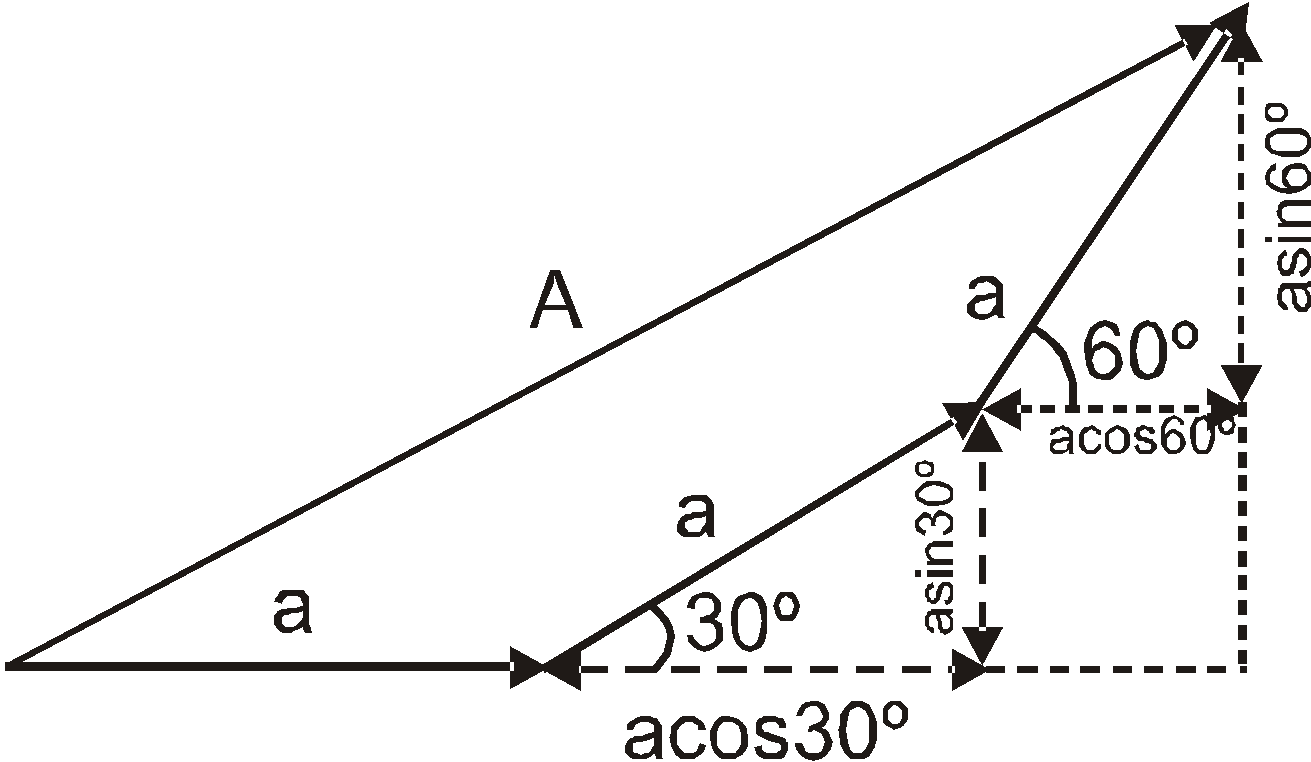
From phasor diagram,
A = 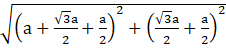
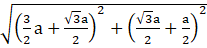
= 
A = 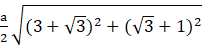 =
= 
Prepare Smarter with CGP Edu
Get practice questions, solutions, and test series in one place.
Write a Review
Share your experience with this question and solution.
Commentary
Send your comment, doubt, correction, or feedback to admin.
Similar Questions
Explore conceptually related problems
The S.H.M. of a particle is given by the equation . The amplitude is
If the displacement equation of a particle be represented by , the particle executes
The motion of a particle varies with time according to the relation , then
The resultant of two rectangular simple harmonic motions of the same frequency and unequal amplitud…
Two mutually perpendicular simple harmonic vibrations have same amplitude, frequency and phase. Whe…
The displacement of a particle varies according to the relation x = 4(cos π π t + sin π π t). The a…